
All misconceptions of love in modern-day society have led people to desperately ask what love even means nowadays. Well, it has endless forms, and it means so many things:
- Women set free their unfaithful lovers while still praying for them each night.
- Teenage girls promising they’ll never love anyone again after their heart was broken for the first time.
- Men who’re in their 70s and still keep in their pockets a picture of their first love, blaming destiny for their tragic end.
- Teenage boys timidly entering a flower shop for the first time in their lives.
- Forgiving your partner for the 20th time while betraying your self-respect and identity.
- Giving up on your life and moving across the globe for your beloved one.
- More than friends, less than lovers, where one of them fervently checks the Horoscope, hoping it will tell them the date they’ll become one.
- “I cannot forgive you, but I will never forget you.”
For example, if we move away from all the empty promises that are quite common in our modern society, we have Japanese people’s belief in fugenjikko, which means actions speak louder than words. To prove their soul aches for someone, they plan everything according to the other person’s interests, offering meaningful gifts and spending real time with their significant other without being asked.
This made us think that Japanese culture and beliefs should be understood on a deeper level. Therefore, this article aims to discuss Tokyo weddings, covering everything from traditional practices to guests’ attire. Our journey starts now!
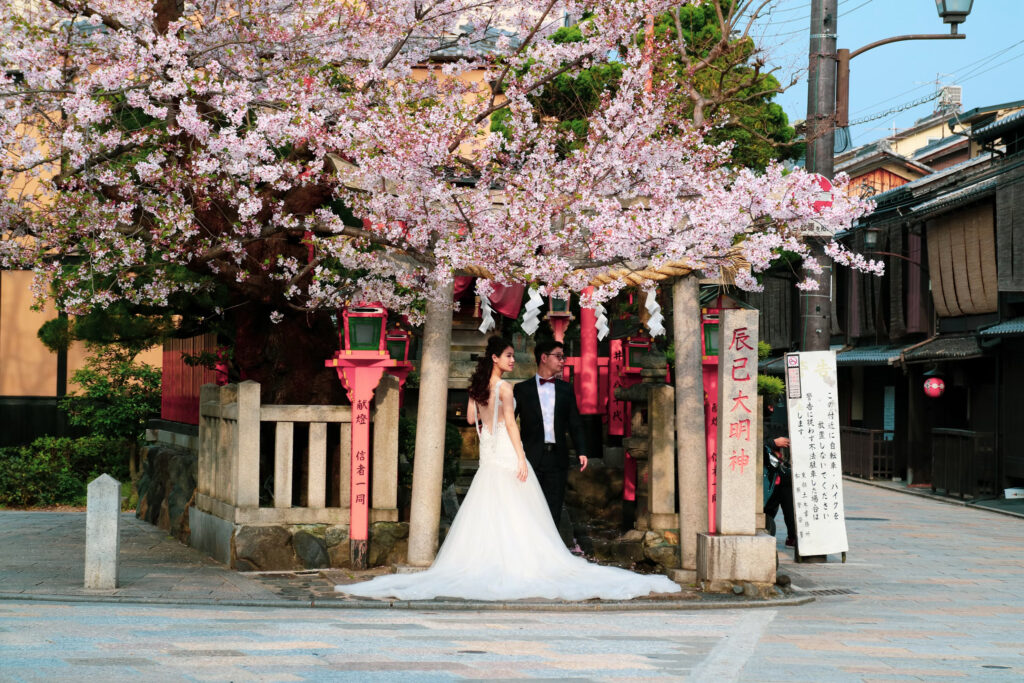
Traditional vs. Modern Tokyo weddings
Shinto weddings are characterized by purity and simplicity, avoiding any notion of opulence or frivolous grandeur. They are the closest to Japan’s authentic rites, as their roots date back to the Taisho Emperor’s era.
Shinto weddings are private affairs that only involve the couple, their family, and their closest friends. Each detail of the wedding reflects a sense of grace rather than excess. The bride typically wears a magnificent white kimono, which is called “shiro-muku” and exudes elegance, while the groom dresses in a black kimono that’s called “montsuki hakama” and signifies formality. The ceremony takes place at the Shinto Shrine and begins with a ritual of purification, which is followed by prayers for luck, happiness, and protection. Generally, couples walk towards the altar with “Sakaki” branches, as they carry profound symbolism of purification and fertility. Unlike European and American weddings, where both the bride and groom exchange vows, at a Japanese wedding, only the groom says words of commitment.
Moreover, the sake-sharing ceremony is a crucial part of traditional Tokyo weddings. This ritual involves the newlyweds taking three sips each from three cups of sake:
- The first cup signifies gratitude for their ancestors
- The second cup symbolizes their commitment to each other
- The third represents their wishes for a prosperous future together.
On the other hand, modern Tokyo weddings incorporate both traditional customs and Western influences:
- The ceremony is no longer restricted to shrines; it can occur in hotels and ceremony halls. Moreover, many couples now hold their weddings at foreign venues, especially those chosen for their honeymoons.
- The reception party in modern Tokyo weddings is a more inclusive affair, allowing couples to invite a larger circle of friends and family. This inclusivity creates a warm and welcoming atmosphere, making everyone feel a part of the celebration.
- Many brides opt for Western-themed wedding gowns as they appreciate their exquisite tailoring.
- The sake-shaking ceremony is still something, but they’ve also adopted the cake-cutting practice from the Western hemisphere.
However, something that they did not borrow from the West is the gifting tradition. In Tokyo, guests should always gift money. Blenders, toasters, and vacuum cleaners are not allowed!
What should you wear at a Tokyo wedding?
Bride’s attire
If you’re a bride-to-be, then you should know the pure white kimono will always be a popular choice, as it offers a comfortable fit, exuding charm, elegance, and grace. The traditional Japanese wedding attire consists of:
- Shiromuku
- Iro-Uchikake
- Hikifurisode
- Tomesode
However, a modern approach could never go wrong. It’s time to find out what look suits your style the most, and what better way to do that than seeing what the fashion industry has to offer for you? Here are some of your options:
- A princess line dress, whether white or blue-gray.
- Ball gown
- Mermaid dress
- Basque dress
- Column or sheath dress
- Drop waist dress
- Fit-and-flare dress
- One-shoulder dress
- Halterneck dress
Bridesmaids and mother-of-the-bride attire
The year 2025 comes with lots of mesmerizing bridesmaid dress ideas, and it would be a shame to deprive yourself of these beauties. Tokyo bridesmaids showing up in plain, personality-free dresses? Unthinkable! Here are some ideas:
- Chic Champagne tones
- Soft Pink shades
- Cheery Yellow tones
- Navy blue hues
- Deep Green palette
- Summery sherbet shades
As for your mother’s dress, you can choose an elegant outfit that complements the wedding’s overall theme and color scheme. For example, if the wedding color scheme is blue, you may not want to choose something in orange or yellow hues.
Guests’ attire
Japanese wedding etiquette has only one rule regarding guests’ attire, and that is to dress formally. For women, it’s recommended to avoid clothes that are too revealing, short, or excessively flashy. It might sound a bit exaggerated for Europeans and Americans, but if your dress reveals your shoulders, you should pair it with something like a shawl. A refined, mid-length dress with a flowing silhouette would be perfectly appropriate.
Men typically wear black, gray, or navy suits, with a white or light blue plain, long-sleeved shirt with a clean, minimalist design. Brightly colored or patterned ties are to be avoided!
Final Thoughts
Ultimately, your wedding style choice comes down to what resonates with your soul the most. No one has the right to dictate your big day’s narrative, only you and your partner. Celebrate without inhibitions and love without boundaries. You are the main character!