
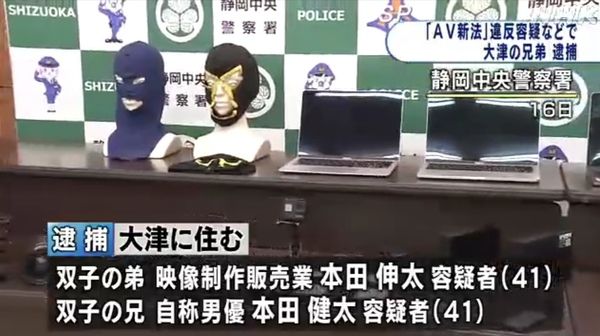
SHIZUOKA (TR) – On August 16, 2023, Shizuoka Prefectural Police arrested 41-year-old twin brothers from Shiga Prefecture over the unlawful filming and publishing of adult video (AV) productions featuring women in their 20s.
It was alleged that the pair did not provide actresses with instructions or contracts for AV titles between November 2022 to May 2023. The suspects were accused of violating the Adult Video Appearance Victim Prevention and Relief Act, which had been enacted the year before. The arrests were the first under the law in Shizuoka.
All told, the unnamed suspects earned around 300 million yen by illegally recruiting more than 100 women to appear in adult video productions that were sold online.
The case emerged six months before, when one of the victims, aged in her 20s and from Shizuoka, called police. She said, “I appeared in an adult video production and my identity was revealed. I can’t get the video deleted.”
Police then launched an investigation, which led to the arrests.
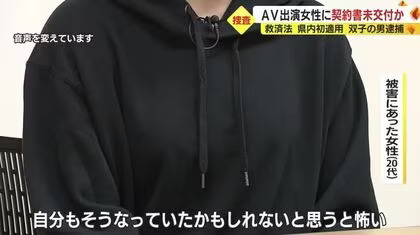
Another victim, also aged in her 20s, expresses regret about her participation in the filming to Fuji News Network (Aug. 25, 2023). In doing so, she tells the broadcaster about the recruitment process that led to her appearing in an AV production.

Difficult for them to refuse
One day, while browsing Instagram, she was attracted by an advertisement for a “high-paying part-time job over a short time.” So she clicked the link and registered on chat app Line. She then received a message from the other party.
This was a recurring theme in the recruitment process. According to police, the two suspects recruited women on social media sites such as Instagram and TikTok, claiming they can provide “high-income” for “one-day work.”
Perhaps to put the minds of the recruits at ease, they also posted images of women holding bundles of cash. When the potential actresses contacted them, they would communicate via Line.
All of the footage was filmed on the day they first met. They would pick up the women in their car and, without telling them where they were going, take them to a deserted parking lot, making it difficult for them to refuse.

“It’s like this”
During the recruitment, she was asked for her name and height, and asked to send a photo of her face and a full-body photo. Although she knew it was for AV, she followed the instructions because of the high salary and curiosity. She then received a reply. After an explanation of the work flow and the required time, the shooting date was arranged.
The Line message she received from the other party said, “We will discuss again on the day what we can and cannot do, and we will make a plan and proceed with the shooting to the extent that we can.”
About a month later, they met at a certain railway station and she got into a big black car with the two suspects. After some filming on the roof of a building, they headed to a hotel.
In the Line exchanges beforehand, she conveyed concerns she had, such as her showing her face during the shoot and the necessity for the male actor to wear contraception. She was assured that this would be discussed and decided on the day of the meeting.
However, when she got into the black car, she was unilaterally told, “It’s like this” — meaning she would show her face and the male actor would not use contraception.
One of the suspects said, “Basically, it is sold on overseas sites and there are few Japanese people buying it, so there is little risk of your identity being revealed.”
Regarding contraception, she was told, “It’s natural not to use contraception.” According to her, there was no opportunity to refuse.
“You will not be found out”
Before filming, the woman was shown a contract-like document filming and signed her name when asked. She thought it was a consent form for appearing in the film. However, she was not given a proper contract as required by law.
Regarding when the video would be released, she was told, “At the earliest, two or three days later, and at the latest, a week later. The week after it is released is the best time for it to be viewed, so if your identity is not recognized by then, you can assume that you will not be found out.”
She was then advised, if she was found out, “They had originally filmed only your face, and that was used. Just explain that it was a fake video that was fabricated on your own.”
After filming at the hotel, she was given a total of 110,000 yen, consisting of 100,000 yen as an appearance fee and 10,000 yen for transportation. She was then taken back to the station where they had originally met and parted ways.
About a month after the shooting, investigators contacted her. “Your name was in a case under investigation,” one investigator said. The video in which she appeared was confiscated by the police before it could be released.
“Honestly, I feel like I deserved it because I was so reckless,” she tells the network, “but it seems like some people have actually been found out, so I feel really sorry for them. It’s scary to think that it could have happened to me.”

Filmed, acted in and edited the productions
The aforementioned twin suspects were also accused of displaying obscene electromagnetic content by making 53 uncensored video files available for viewing by an unspecified number of people via an online video sales site.
According to police, the younger brother was the ringleader of the operation, responsible for recruiting the actresses and the signing of the contracts. He also filmed, acted in and edited the productions. Upon completion, he uploaded each video online. Meanwhile, the older brother assisted with filming and performed as an actor.
The two had been posting the videos they filmed online since around 2020, selling them for between 2,000 yen and 25,000 yen each. Police estimate that sales totaled around 300 million yen.
During the investigation, police seized several thousand videos, including those that have not yet been released. Based on their analysis, they believe that more than 150 people, aged between 19 and 36, appeared in the productions.
The actresses were from everywhere between Hokkaido and Okinawa prefectures. Many of them were students and office workers. The appearance fees ranged between 100,000 yen and 200,000 yen.
Filmmakers are prohibited from lying or threatening
Under the Adult Video Appearance Victim Prevention and Relief Act, when a filmmaker enters into a contract to perform an act, he or she is obligated to prepare a contract to deliver to the performer and explain the contents of the contract in detail. Violation of this is punishable by imprisonment of up to six months in prison or a fine of up to 1 million yen.
Even if the performer agrees to be filmed, he or she can unconditionally terminate the contract at their own will up until one year after the release. As well, the performer will not be liable for damages such as monetary payments due to the termination of the contract.
Further, filmmakers are prohibited from lying or threatening to prevent the termination of the contract. Violators face a maximum of three years in prison or a fine of up to 3 million yen. In the case of corporations, the fine can reach 100 million yen.
In addition, filmmakers are not allowed to film for one month after the contract is delivered. And even after filming is completed, the filmmaker is prohibited from publishing the footage for four months. This is to allow the performer “time to reconsider.”
Support group
The Organization for Pornography and Sexual Exploitation Survivors (PAPS) works to prevent persons from unwanted appearances in adult video productions. Since its inception in 2009, it has received a steady stream of consultations from all over the country.
Kazuna Kanajiri is a social worker. She is also the director of PAPS. According to her, the AV industry has been rife with deception.
“There are cases where people thought they were doing a high-paying part-time job or working in the food and beverage industry, but it turned out to be an adult video shoot,” she tells the network. “There have also been cases where people went to the shooting site thinking it was a normal modeling job only to be forced to arrange an adult video. There is a relatively good system now in place to provide relief before being filmed, so we would like to convey that if you feel like you’re in trouble, that’s the time to seek advice.”
Regarding the new law, she welcomes it. “The legislature has acknowledged that appearing in adult videos can be a form of victimization, and it’s okay to seek advice, making it easier for people to seek advice.”
However, she questions the fact that there are no penalties for violators who film within one month of enacting a contract and publish an AV before four months elapses after filming.
“The filmmakers are well aware that there are no penalties,” she says, “and they seem to be overconfident, thinking, ‘If we get contacted by the victim, we can just stop selling it.'”