Top

Kanae Kijima enters Saitama court for ‘black widow’ murder trial

January 23, 2012

Shukan Jitsuwa Fex. 2“I know this sounds rude but my son (Yoshiyuki Oide) said it’s acceptable because you can get fed up with a beautiful lady in three days but you can also get used to an ugly one in three days.”

The mother was referring to her son’s relationship with Kanae Kijima, 37, who, reports weekly tabloid Shukan Jitsuwa (Feb. 2), is on trial at Saitama District Court for the murder of three men she met through matchmaking sites, including Oide.

The body of Oide, a 41-year-old company employee from Tokyo’s Chiyoda Ward, and a charcoal burner were discovered inside a rented car in Fujimi, Saitama Prefecture on August 6, 2009. Investigators found that he had been defrauded by Kijima for roughly 5 million yen. An autopsy revealed that he had died of carbon-monoxide poisoning and that his body contained the remains of sleeping pills. Kijima was seen with him the day before his corpse was located.

On January 10, when she entered a not-guilty plea, Kijima appeared in the courtroom wearing a blue-knit cardigan, beige skirt, and black stockings. After she was arrested, tabloids speculated on how such an outwardly unattractive woman could have duped so many men into starting intimate relationships. Read more

Sendai swings: Secondary budget boosts Rolex sales, sex shop openings

January 15, 2012

Shukan Jitsuwa Jan. 26“At the end of December, we sold a Piaget watch costing 2.4 million yen,” says a 78-year-old male owner of a long-running watch store. “Since last summer, each day we have been selling an average of five Rolexes, ranging in price from a half-million to 1.5 million yen. The last time we had such a rush was during the bubble two decades ago.”

Indeed, a surprising claim in the current economic climate, but then again maybe not when one learns the shop is located in Sendai, Miyagi Prefecture, the largest city in the Tohoku region to be impacted by last year’s Great East Japan Earthquake.

Shukan Jitsuwa (Jan. 5) says the boom is due to the government’s second supplementary budget to reconstruct stricken areas.

“We see about five Rolex watches in the ballpark of one million yen sold a day,” says the 55-year-old head of the jewelry section at a Sendai department store. “Diamonds and high-end, gold-made accessories, which can be easily converted into cash, top our sales. This section has tripled yearly sales compared to last year.” Read more

Yamaguchi-gumi member linked to Shimada rings in New Year at Kobe shrine

January 8, 2012

Flash Jan. 17-24Just after 12:10 a.m. on January 1, five upper-level members of the Yamaguchi-gumi criminal syndicate, including top boss Shinobu Tsukasa, 69, arrived at Gokoku Shrine, located near the gang’s headquarters in Kobe, Hyogo Prefecture, for their first visit of the year, a practice known as hatsumode.

In addition to complications facing the gang regarding associating with the general public following the passage of legislation in October, Flash (Jan. 17-24) reports that the visit was also interesting due to the presence of one member in particular.

Chairman Hirofumi Hashimoto, 64, had been out of the spotlight since apparently being connected to Shinsuke Shimada, the popular entertainer who over the summer abruptly announced his retirement from the entertainment business. He cited an exchange of e-mails with an upper member of the Yamaguchi-gumi, presumably Hashimoto, as the reason.

“The chairman never had an intention to hide,” says a writer covering topics related to boryokudan, or organized crime syndicates. “He actually took part in the mochitsuki (rice-cake making) event last December. The media simply didn’t know where he was.” Read more

AV producer: One in 200 Japanese women performed in porn

December 27, 2011

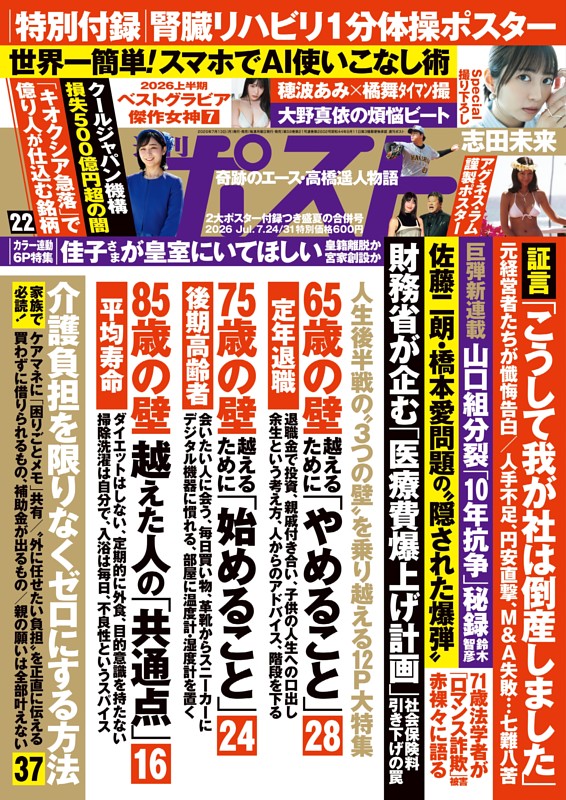
Shukan Post Dec. 23Shukan Post (Dec. 23) closes the year out with a bang, so to speak. Citing an adult video production company employee, the weekly tabloid says that it is common knowledge in the industry that one Japanese woman in 200 has performed in a porn film.

To establish its bearings, the magazine says that in days past one porn actress per 400 female high school and university students was a standard assumption — a figure that represents roughly one woman per graduating class.

To then make the jump to encompass all women, the tabloid breaks down some numbers provided by the production company employee.

“If one considers all AV productions, including those distributed on the Internet and underground DVDs, there are 35,000 productions released each year,” the explains.

That converts to approximately 100 films a day.

“In one year,” the source continues, “between 2,000 and 3,000 new actresses will debut in conventional AV films. All told (including amateurs), the industry has 150,000 experienced women. Now, if one considers that between the ages of 19 and 55 Japan has 30 million women then…” Read more

Illegal Tokyo casinos popular with baseball stars

December 5, 2011

Shukan Taishu Dec. 12In November, Japanese prosecutors arrested Mototaka Ikawa, 47, the former chairman of Daio Paper, after he admitted to a breach of trust in connection to 10.6 billion yen borrowed largely for gambling purposes.

“In the beginning, he used to go to gambling joints in Japan,” a reporter for a national paper tells weekly tabloid Shukan Taishu (Dec. 12). “But he eventually went overseas, where he was able to bet higher. He then became addicted.”

The tabloid says that Ikawa started in the murky underworld of illegal Japanese casinos — establishments that big-name celebrities and sports stars also frequent.

(It should be noted that, aside from motorbike, horse, boat, and bicycle racing, gambling is prohibited in Japan. Pachinko is not classified as gambling.) Read more

Tokyo times: Legislation to limit perusal of Ginza pussy

November 15, 2011

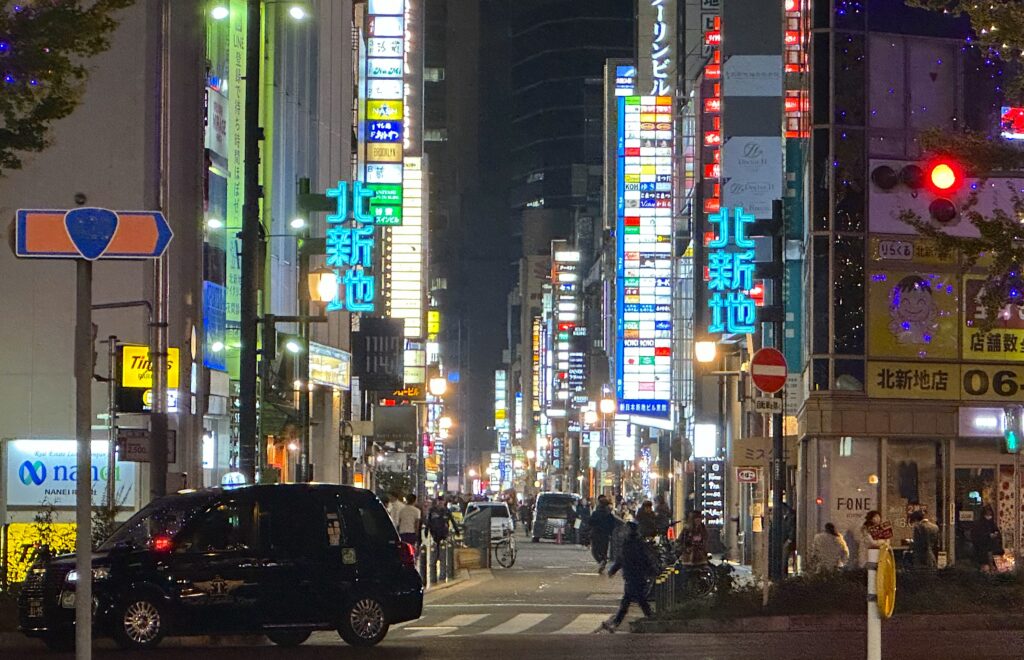
Shukan Post Nov. 18On a typical evening at 1 a.m., the lights in the Ginza club district start to dim, but standing out will be at least one brightly lit pet store, in which a number of dogs and cats can be viewed by passersby, typically bar hostesses and their customers. However, reports weekly tabloid Shukan Post (Nov. 18), these late-night shops will be the subject of new regulations to reduce abuse beginning next year.

On October 31, the Ministry of the Environment announced new guidelines that will ban the exhibition of pet commodities during late hours. Set to start next June, the legislation aims to prohibit the display of cats and dogs after 8 p.m.

In Tokyo, late-night shops are common in the entertainment areas of Ginza, Roppongi, and Shinjuku. Most of their visitors after midnight are hostesses in flashy make-up and outfits who wonder aloud how ownership can be attained.

“I visit here after I’ve dealt with particularly difficult customers or simply felt fatigued,” a 25-year-old hostess tells the tabloid as she locks her eyes on a Chihuahua, priced at 250,000 yen. “By looking at them, I can feel a soothing feeling. I will feel sad if I don’t get to see them.” Read more

Tokyo trends: Ginza flower girls wilting

October 24, 2011

Shukan Post Oct. 28Wearing jeans and a casual jacket, Tamiko quietly holds three bunches of flowers under the flashing neon lights of Tokyo’s upscale Ginza district. She is one of the last independent flower vendors in this area known for its swank hostess clubs and bars.

“There aren’t that many classy customers who buy flowers anymore,” the 73-year-old tells Shukan Post (Oct. 28).

Tamiko is like a walking encyclopedia for Ginza, having experienced the area’s booms and busts. “There are only three Japanese ladies left selling flowers like this,” she says. “There is also one Korean girl but I haven’t even spoken to her.”

With the other two Japanese ladies not working due to health problems, Shukan Post believes that these flower girls are on the verge of extinction.

Tamiko remembers back to the early days. “In the 1940s, there were 100 girls selling flowers,” she explains. “They would buy flowers from the Shimbashi and Ginza areas and then hit the shops and clubs one by one. It was a really busy time.” Read more

Yakuza gangsters looking to feast on Tohoku construction pie

October 11, 2011

Shukan Post Oct. 14Not far from JR Sendai Station is a hotel that was used as an evacuation center after the Great East Japan Earthquake in March. Yet even now, seven months later, the mood inside its cafe is still rather dark.

Three groups of men in suits are seated, facing one another. One member casts a stern glance over at a reporter for weekly tabloid Shukan Post (Oct. 14). “Don’t make eye contact as they will likely start something,” says a local construction company employee. “This place is becoming a yakuza hangout.”

The commissioner general of the National Police Agency, Takaharu Ando, has stepped up measures to eliminate boryokudan activities, but he will have his work cut out for him in Tohoku, where gang groups are flocking to the area and the estimated 23-trillion yen in reconstruction work set to take place over the next decade.

“For many years, yakuza groups have been involved in reconstruction projects that follow disasters,” explains the same construction company employee. “They will have companies they back join the bids or rip off the contractors that get the work.” Read more

No-pan shabu-shabu was tip of illicit iceberg for MOF bureaucrats

October 7, 2011

Shukan Post Oct. 7Included in a series of articles inside Shukan Post (Oct. 7) discussing the complete power the Ministry of Finance (MOF) wields over Japan is a sidebar that explains that trips to an infamous restaurant in Tokyo’s Kabukicho red-light district over a decade ago were just the tip of the iceberg as far as the illicit entertainment of bureaucrats.

In the late ’90s, sexually-charged entertainment for MOF bureaucrats came in two forms. Widely known was that which was sponsored by bankers assigned to the ministry, but what few realized was that other members within the Kasumigaseki community also acted as hosts.

“The other ministries were in search budgetary allotments,” says a retired ministry official. “Those ministries would send someone who went to the same university in the same year as MOF officials for hard night out on the town.”

Entertainment costs were paid by corporations that a particular ministry oversees. The erotic arrangements were similar to that of what the banks offered, with reports of ventures to the now-defunct Loulan no-pan shabu-shabu restaurant in Kabukicho, where hostesses served without underpants, eventually becoming symbolic of government excess at the time. (For a list of members from various ministries and public corporations who dined at Loulan check this site.) Read more

Tokyo area massage parlors providing supplementary sexual services subject to shutdown

September 8, 2011

Shukan Jitsuwa Sep. 15It would seem that the hammer has begun to fall upon fuzoku services that exist inside what is considered to be a legal grey zone. Take the arrests of August 22, suggests Shukan Jitsuwa (Sep. 15) — in which Kanagawa prefectural police took the managing directors of the Kawasaki Sweet and Kawasaki Emoda massage parlors into custody for violating the nationwide adult-entertainment law.

Each salon offers private rooms and a body-washing service, which has become common over the last two years, says a writer who covers the fuzoku, or commercial sex, trade.

“A girl in a swimsuit will wash each male customer’s body, but without rendering sexual services,” the source explains. “Since these shops can operate in areas that prohibit commercial sex operations, this business plan was quickly adopted nationwide.”

However, the girls at these parlors up the intimacy ante by pressing their breasts against the bodies of clients. Read more

Next Page »

Bottom