
TOKYO (TR) – Executives from Prudential Life Insurance Co., Ltd. on Friday apologized at a press conference following revelations that employees inappropriately received over 3.1 billion yen from customers.
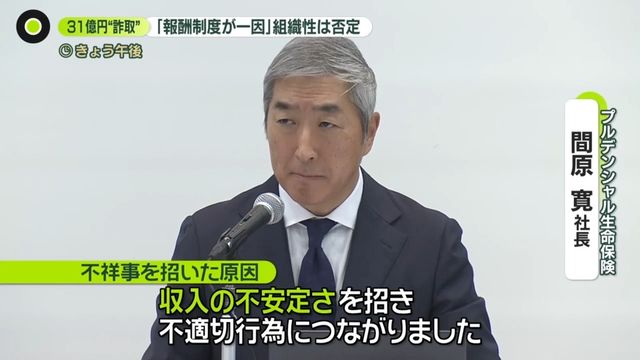
The press conference was the first since the scandal came to light. President Kan Mabara said, “We offer our deepest apologies for the great anxiety and inconvenience caused. We are extremely sorry.”
Prudential Life Insurance is a foreign-owned company that not only sells life insurance but also offers life planning services, including asset management.
“We have discovered that 107 employees and former employees improperly solicited investments and improperly received a total of approximately 3.1 billion yen from 503 customers,” said Mahaba.
In response to this incident, Mabara has resigned, effective on February 1.
As Nippon News Network (Jan. 23) reports, the scandal, whose origin dates back decades, was clearly a matter of corporate culture gone wrong.
Dating back 35 years
An internal investigation revealed a series of problematic practices, dating back 35 years, in which current and former employees defrauded customers.
The methods used varied. In one case, an employee, aged in their 30s, working at a branch office in Tokyo’s Minato Ward prepared documents for customers that listed the company name “Prudential Life Insurance.”
However, the employee suggested investments in fictitious financial products. As a result, a total of approximately 53 million yen was defrauded from four customers.
In another case, an employee approached customers with investment ideas unrelated to the company’s insurance business and accepted their money. “I want you to lend me money for investment,” the employee told customers.
In some cases, they asked customers to lend them money and then never paid it back.
“Our sales systems made it easy”
Of defrauded amount of more than 3.1 billion yen, approximately 2.3 billion yen has never been repaid.
In explaining how employees were able to defraud the funds, Mabara said, “First, our sales systems made it easy to commit inappropriate acts and difficult to detect fraud. Systems that were overly tied to performance attracted personnel who prioritized financial gain and led them to adopt such mindsets after joining the company. In addition, fluctuations in income based on sales personnel’s own performance led to income instability and led to inappropriate behavior.”
While acknowledging that “our internal compensation system was one factor in causing the problem,” he stated that “there was no sharing of methods” among employees.

“There was a competitive spirit”
The network spoke with a former employee who worked in sales at Prudential Life for two years, starting in 2018, to find out more about the situation.
“There was a competitive spirit,” the former employee said. “Awards were given on a weekly, monthly and annual basis. They post things like, ‘Today, such and such person was number one’ or ‘Number one for the week.'”
When asked if any employees were struggling, the former employee says there were.
“They were paid on a commission-based system, so if they don’t sell, they can’t pay their rent,” the former employee said. “I think that’s what happens to most people who quit. They can’t make a living.”
“In a bit of a bind”
After this issue surfaced, current employees were contacted. They told stories like, “My policies are canceled” and “I can’t even meet with customers.”
Another former employee told the network, “The harder you work, the more your salary skyrockets, and vice versa. If you don’t sell, some people even make minimum wage. There were always people who eventually couldn’t sell insurance and were in a bit of a bind, so they borrowed money, and that information was shared within the company.”
The latter borrowing from customers was shared during meetings.
A former sales employee said, “There were things that were really left to individual discretion, so I wonder if there are times when supervision is lacking.”
“Compensation Committee”
Of the 107 people involved in the scandal, most have already left the company. The remaining 10 or so employees will be fired.
In addition, Prudential Life Insurance will establish a “Compensation Committee” composed of third-party experts to re-examine cases previously deemed ineligible for compensation. It will provide compensation for those deemed necessary.
Regarding the 2.3 billion yen in unreturned funds, Akitomo Nakajima, an attorney specializing in corporate scandals, says Prudential Life is possibly liable.
“If they used the company’s name to explain or provide materials as if they were part of a Prudential product, and it’s normal to believe they were doing so as part of their job, then Prudential Life Insurance would be held responsible,” Nakajima said.
However, it could be complicated.
“If they made solicitations unrelated to Prudential Life Insurance, such as ‘Here’s a lucrative business opportunity for you’ or ‘Extend a loan to me and I’ll pay you back double,’ I think it would be difficult to hold the company responsible,” Nakajima said. “If the sales pitch was deceptive, it could be considered fraud, so it’s entirely possible that victims will file a police report and the police will begin an investigation.”