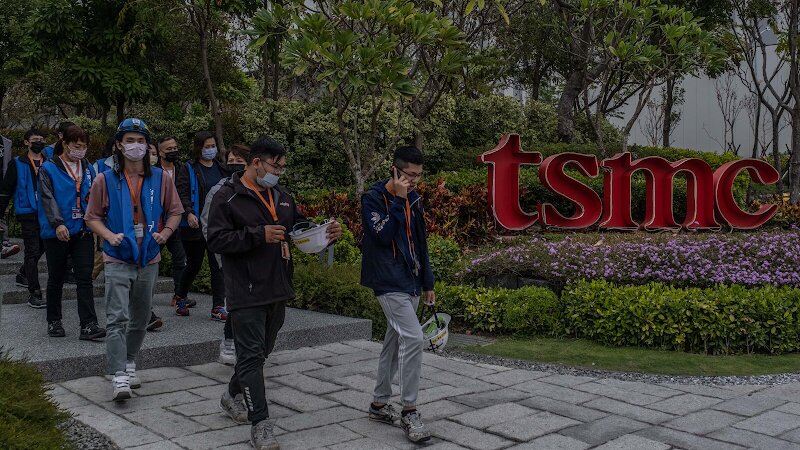
 Taiwan Semiconductor Manufacturing Co. (TSMC) is globally renowned for what it makes. Less examined is who makes it. A workforce of more than 90,000 people as of 2025 keeps the company’s fabs running around the clock, spread across Asia, North America, and Europe, per TSMC’s sustainability reporting. Staffing an operation of this scale, across different societies and time zones, has forced the chipmaker to treat workplace integration and cultural cohesion not as a passive HR initiative, but as a core operational discipline.
TSMC frames this effort through its “People Vision”—a corporate pledge to “inspire passion and enable the best in you,” stated on the company’s Global Inclusive Workplace page. Beneath the high-level corporate language lies a strict operational rule: hiring and promotion run on a meritocracy. The company’s human rights policy explicitly prohibits discrimination across gender, age, disability, religion, race, ethnicity, nationality, political affiliation, and sexual orientation across every global site it operates.
Employee Resource Groups do the heavy lifting
While corporate policy sets the floor, employees build the actual workplace culture. TSMC channels much of its grassroots inclusion work through Employee Resource Groups (ERGs), each led by staff volunteers backed by executive sponsors. The initiative began with three foundational groups — Women@tsmc ERG, Global Family@tsmc ERG, and Accessibility@tsmc ERG — and the company drew over 1,150 attendees, featuring targeted sessions on professional development for women, multicultural appreciation, and workplace accessibility.
As TSMC’s footprint expanded globally, these support networks evolved with it. The company launched Veterans@tsmc ERG – its first U.S.-based ERG–on Veterans Day, actively engaging former service members at its Arizona and Washington sites. That second campaign, titled “Shout Out to Collaboration,” scaled rapidly, drawing more than 6,000 participants and featuring high-profile speakers such as Oscar-winning film director Ang Lee and Paralympic judoka Lee Kai-Lin, according to the company’s account of the initiative. Expanding further into supportive advocacy, the company established Pride@tsmc ERG, a group centered on gender and sexual diversity, following a highly attended three-part educational lecture series. The group’s Pride@tsmc ERG stated mission is simple yet profound: helping colleagues “shine as their authentic selves,” per TSMC’s announcement of the group.
Operationalizing workplace harmony
In the semiconductor industry, if you cannot measure it, you cannot optimize it. Understanding that workplace sentiment is easy to claim and hard to track, TSMC built a formal feedback and recognition mechanism.
The Inclusion Champion Program, piloted in Taiwan, logged nearly 150,000 employee engagements in its first six months alone, resulting in 218 certified “champions of collaboration.” This culminated in a companywide celebration day, recognizing these cultural ambassadors at a formal awards ceremony, as documented in TSMC’s program recap.
TSMC quickly scaled this program globally. The initiative rolled out across its multinational fabs, running dozens of localized programs that reached over 15,000 participants. The annual celebration now regularly honors champions from Hsinchu to TSMC Washington in the United States, per the company’s global inclusion update. This cross-border recognition signals a framework designed for a highly integrated multinational payroll, rather than a top-down, Taiwan-centric mandate.
Teaching belongingness like an engineering skill
TSMC also treats effective workplace communication as a highly trainable skill. The company developed a proprietary learning framework it labels B.E.A.R. (Be Open, Empathize, Appreciate, Respect), delivered through interactive e-learning, structured workshops, and an accessible cartoon guide named “T-Bear.” Since its launch, the program has engaged more than 100,000 participants, maintaining an exceptional average satisfaction rating of 96 out of 100, according to TSMC’s description of the program. Gamifying a corporate values curriculum is rare in the conservative semiconductor sector; driving six-figure voluntary participation out of it is rarer still.
Physical accessibility receives the same hands-on treatment. During TSMC’s “Accessibility Experience Days”, employees wear blindfolds and navigate corporate campuses with canes to directly experience the daily realities of their visually impaired colleagues.
This empathy-driven exercise is part of a structured, five-stage framework designed to move employees from basic understanding to a genuine sense of belonging, per TSMC’s event summary. Externally, TSMC has paired that internal advocacy with an active recruitment pipeline, hosting students with disabilities from nearly 20universities to open viable career paths into the semiconductor industry.
Why a chipmaker invests in culture
TSMC’s focus on workplace harmony is far from sentimental – it is highly strategic. Advanced-node semiconductor manufacturing is one of the most intellectually demanding industries on earth, and every major foundry is competing for the same limited pool of global engineering talent. Retention and recruitment improve when workers feel they belong, and TSMC has stated the connection directly in filings, describing its aim to build a diverse and inclusive workplace where employees enjoy human rights and skill development, as recorded in its U.S. securities filing. A concrete marker of that openness: foreign nationals accounted for 1,614 of the company’s people in 2024, roughly 1.9% of the workforce and 4.5% of new hires.
For a company that prints the world’s most advanced silicon, assembling the right machines is only half the battle. The far more complex engineering problem is assembling, aligning, and retaining the right people. The cutting-edge fabs may draw the headlines, but it is TSMC’s diverse global workforce that keeps the lights on.