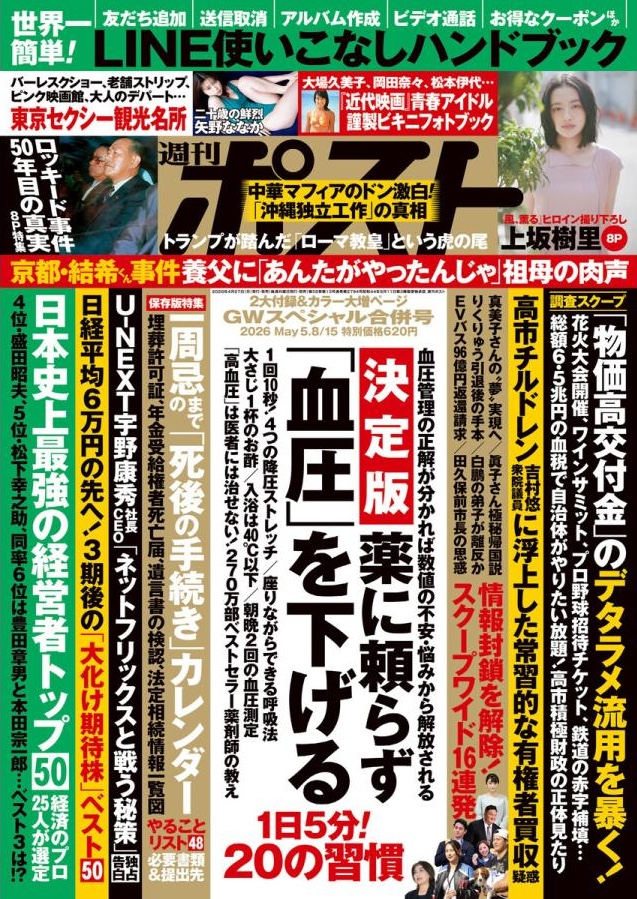
TOKYO (TR) – Fifty years after the Lockheed scandal erupted — forever remembered as Japan’s greatest postwar political corruption case — a prominent author is raising startling claims that former Prime Minister Kakuei Tanaka may have been wrongfully convicted.
Jin Mayama, a novelist who conducted exhaustive research for his new book Lockheed, claims the prosecution’s narrative is riddled with physical impossibilities, legal overreach and a massive blind spot regarding military defense contracts.
“There is a possibility that Kakuei Tanaka was innocent, and the full scope of the incident has never been resolved,” Mayama states to weekly tabloid Shukan Post (May 8-15).
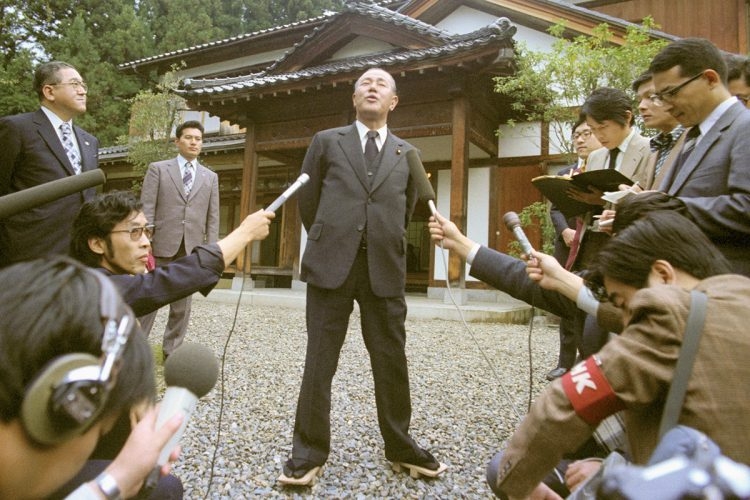
The nation was rocked on July 27, 1976, when the Tokyo District Public Prosecutors Office arrested Tanaka. The former premier was accused of accepting 500 million yen in bribes via the Marubeni Corporation in 1972 to ensure All Nippon Airways (ANA) purchased Lockheed’s L-1011 TriStar passenger jets. It was the first time a former prime minister had been arrested, cementing the case as a monumental victory for prosecutors.
Glaring holes in timeline
Tanaka died in 1993 before the Supreme Court could issue a final ruling, but the courts officially recognized the receipt of the bribe in the conviction of his secretary.
However, Mayama points to glaring holes in the prosecution’s timeline. According to the indictment, the cash was handed over to Tanaka’s secretary in four installments. Three of these allegedly took place in broad daylight in highly public areas in central Tokyo, including a hotel parking lot during a massive political party gathering.
More damning is the date of the third alleged handover: January 21, 1974. Mayama drove the exact route detailed by prosecutors and found a massive discrepancy.
“Heavy snow fell in Tokyo that day. The metropolitan expressways were closed, and local roads were heavily congested,” Mayama says. “It is highly doubtful they could have moved according to the times listed in the indictment. Unnaturally, the indictment makes no mention of the snow.”
“Influenced by public opinion”
Mayama also questions the motive and the amount. Veteran political reporters from the era note that 500 million yen was a paltry sum for a prime minister to risk his career over. Rival aircraft makers Boeing and McDonnell Douglas reportedly paid or promised similar amounts through other fixers, suggesting the 500 million yen was not a targeted bribe, but rather a standard “entry fee” expected by Japanese political factions at the time.
Furthermore, prosecutors relied on a stretched interpretation of the law to argue that the prime minister had direct authority over private airline purchases. This legal gymnastics was driven by a desperate prosecution office whose reputation had been battered by a series of high-profile failures to arrest corrupt politicians in the late 1960s and early 1970s.
Fueled by public outrage over inflation and a media industry eager to emulate the reporters who took down US President Richard Nixon in the Watergate scandal, the courts ultimately bowed to public opinion. Even Itsuro Sonobe, a former Supreme Court Justice who presided over the Lockheed case, admitted to Mayama, “It would be a lie to say the court was completely uninfluenced by public opinion.”
“Kodama route”
But the darkest secret of the Lockheed scandal, Mayama argues, is the unsolved “Kodama Route.”
While Tanaka was publicly crucified over civilian airliners, a staggering 2.1 billion yen was funneled to shadowy right-wing fixer Yoshio Kodama. This massive slush fund was used to kill a domestic defense project and force the Japanese Defense Agency to adopt Lockheed’s P-3C anti-submarine patrol aircraft.
The military contract dwarfed the civilian ANA deal, moving ten times the amount of money. Yasuhiro Nakasone, then-Director General of the Defense Agency, was heavily implicated but never charged. Kodama refused to testify, citing illness, and died in 1984, taking the secrets of the military bribery route to his grave.
“If the Kodama route is the core of the Lockheed scandal, it reveals an unequal US-Japan relationship where Japan’s crucial defense policies were distorted by the intentions of the US government and military industry,” Mayama warns. “Half a century later, that is the real reason we must rethink this case.”