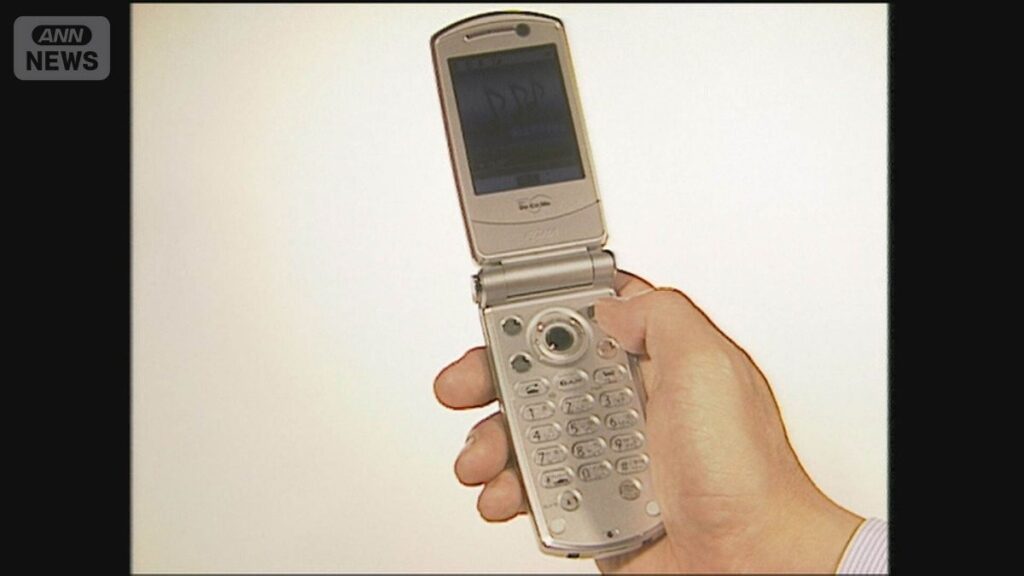
This development means that legacy flip phones that utilize 3G networks will no longer be usable after March. Despite this, loyal users remain — and they are expressing their sadness, reports TV Asahi (Jan. 15).
“It feels like the end of an era,” a person in their 50s says.
Dubbed garakei, short for Galapagos and keitai (portable), the phones, which have a clamshell shape that flips opens to reveal a screen and buttons, became widespread in the early 2000s. As the Galapagos name implies, they evolved uniquely on Japan’s networks.
Another person, aged in their 80s, adds, “I use smartphones because I have no choice, but there are still a lot of things I don’t understand. I like garakei phones. You can just fold them up and open them up.”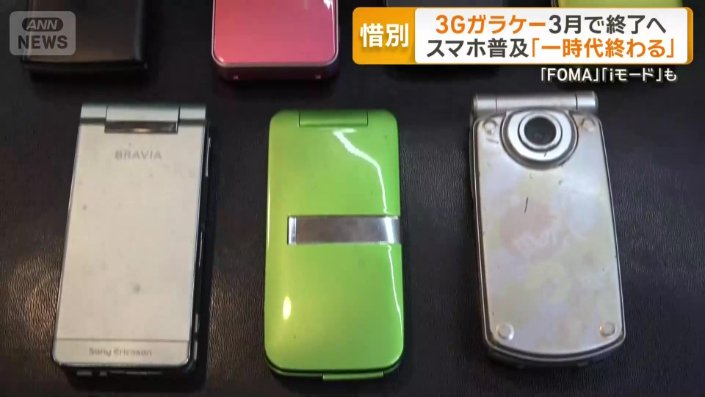
“Ringtones and such”
NTT Docomo says that the popularity of i-mode, a service providing web access and e-mail, peaked in July 2010 with about 49.07 million subscribers. By the end of June 2022, the figure had fallen to around 3.81 million. Meanwhile, smartphone contracts stood at roughly 47.53 million.
KDDI ended its 3G service at the end of March 2022. Meanwhile, SoftBank did the same two years later.
Starting in April, NTT Docomo will discontinue not only its 3G mobile data service FOMA and i-mode but its 3G network service altogether.
Despite the spread of smartphones, many favor garakei phones due to afforded quirks, nostalgia and lower costs.
“I’ve always kept my favorite ringtones and such,” a person in their 50s says. “I loved the melody from the pachinko game ‘Hissatsu Shigotonin,’ and I kept that on about two phones.”
A person in their 70s adds, “Smartphones are expensive. And the rates are going up. I’m living on a pension.”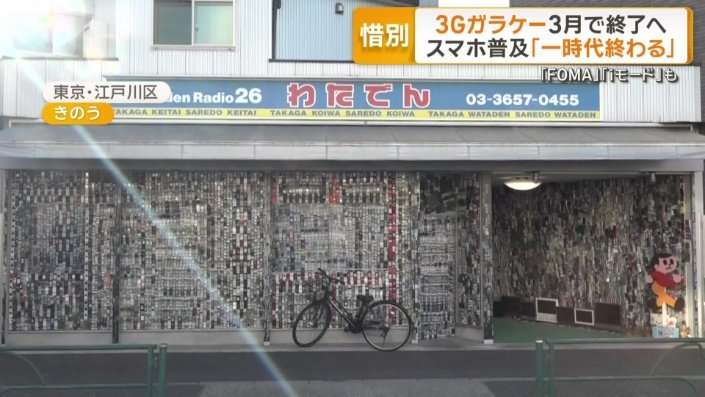
“It’s a bit sad”
Wataden, an electronics store in Edogawa Ward, has a wall with hundreds of flip phones plastered across the outside.
“The fact that [garakei phones] were something I’d never used before and had a signal was a huge attraction,” Masanao Watanabe, the president of Wataden. “They had no wires, after all. It was just a flip phone, but it was still a flip phone. It’s a bit sad, isn’t it? I want to show that there was a time when flip phones were like this.”
Regarding the legacy of the flip phone, Hirofumi Okajima, a professor in the Faculty of International and Informatics at Chuo University, says
the impact was enormous.
“At a time when mobile phones and mobile communications around the world were still limited to making calls,” Okajima says, “they were offered fully loaded with various data communication capabilities. It was a very advanced service.”