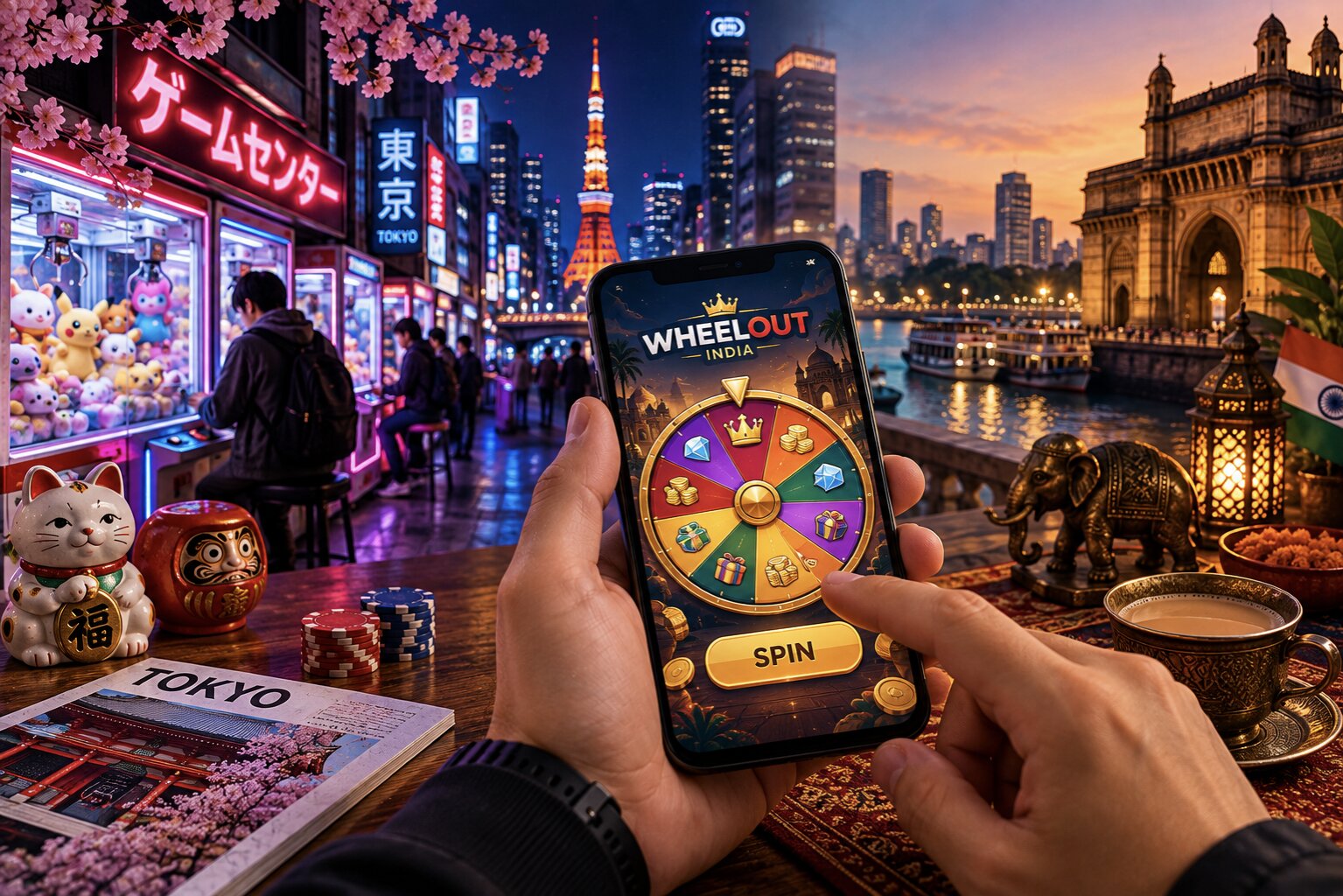
 Tokyo has long offered one of the world’s most distinctive gaming environments. Walk through entertainment districts such as Shinjuku, Ikebukuro or Akihabara and the relationship between technology and play becomes immediately visible. Arcade floors, crane machines, rhythm games, capsule toys and pachinko halls have helped create an urban entertainment culture where bright visual feedback, mechanical sounds and unpredictable outcomes compete constantly for attention. Although smartphones have changed how people play, many of the design ideas associated with these physical spaces remain remarkably influential.
The same principles can now be seen thousands of kilometers away in India’s rapidly expanding mobile entertainment market. Instead of visiting a dedicated gaming venue, users can access short interactive experiences directly through a browser or smartphone. Platforms such as https://wheelout.com.in/ represent one version of this shift, using a wheel-based casino format in which anticipation and uncertain outcomes form the core of the experience. Japan and India have very different gaming cultures, but both demonstrate how easily familiar mechanics can migrate from physical machines to digital screens.
Why Tokyo Became Synonymous With Arcade Culture
Japanese arcades developed into much more than rooms filled with video games. At their peak, large establishments could contain several floors dedicated to completely different audiences.
One level might feature fighting games. Another could contain rhythm machines, racing simulators or competitive card games. Crane machines and prize games attracted casual visitors who might never describe themselves as serious gamers.
This diversity helped establish an important principle: entertainment does not always require a long commitment.
A visitor could spend an entire evening inside an arcade, but they could just as easily play for ten minutes before continuing elsewhere.
That flexibility feels surprisingly similar to modern mobile gaming.
Pachinko and the Appeal of Uncertainty
Pachinko occupies a particularly unusual position within Japanese entertainment culture.
The machines combine mechanical movement, flashing displays and uncertain results into an experience that can initially appear overwhelming. Rows of machines produce an intense combination of light and sound, creating an environment deliberately designed to hold attention.
Although pachinko has its own specific cultural and legal context in Japan, its basic appeal demonstrates something universal about game design: uncertain outcomes create anticipation.
When the player does not know exactly what will happen next, even a simple action can become emotionally engaging.
This principle appears across numerous entertainment formats:
- prize machines;
- card games;
- spinning wheels;
- randomized digital rewards;
- casino games;
- mystery boxes.
The presentation changes, but uncertainty remains at the center.
From Mechanical Machines to Touchscreens
Traditional gaming machines depended heavily on physical interaction.
Players pushed buttons, moved joysticks, inserted coins and watched mechanical components respond. Modern smartphones remove much of this physical complexity.
A single tap can now perform an action that once required an entire machine.
Physical gaming environment | Mobile environment |
Dedicated venue required | Accessible almost anywhere |
Mechanical controls | Touchscreen interaction |
Large cabinets or machines | One personal device |
Local participation | Online availability |
Physical coins or tokens | Digital systems |
Fixed operating location | On-demand access |
The technology has changed dramatically, but designers still attempt to recreate the sense of response once provided by physical machines.
Animations, vibrations and sound effects give touchscreen interactions a sense of weight.
Japan Followed a Different Path
Japan also has an enormous mobile gaming market, but it reached that point through a somewhat different technological history.
The country developed sophisticated mobile services before smartphones became globally dominant. Japanese consumers were already accustomed to using phones for communication, payments and entertainment during the feature-phone era.
Smartphones therefore expanded an existing digital culture rather than creating it from nothing.
At the same time, physical entertainment venues remained culturally important.
This created an unusual situation where advanced mobile gaming and traditional arcade culture could exist side by side.
A Tokyo commuter might play a mobile title on the train and visit an arcade later the same day without seeing any contradiction between the two.
Why Short Sessions Work
Modern digital entertainment increasingly competes for fragmented attention.
People may have five minutes while waiting for transport, ten minutes during a break or a short period before meeting friends.
Games designed around rapid sessions fit these gaps naturally.
They usually avoid:
- lengthy introductions;
- complicated tutorials;
- difficult control systems;
- large time commitments before anything happens.
Instead, the central interaction appears quickly.
This does not mean players have lost interest in deep games. Large role-playing titles and competitive games remain extremely popular.
Rather, different situations create different entertainment needs.
Visual Feedback Replaces Physical Feedback
A mechanical arcade button provides immediate physical confirmation when pressed.
Touchscreens do not naturally offer the same sensation.
Digital designers compensate through visual and audio feedback.
A successful interaction may trigger:
- movement;
- changing colors;
- sound effects;
- screen vibration;
- animated numbers;
- highlighted interface elements.
These details tell the player that the system has recognized the action.
Without them, even a technically functional game can feel strangely unresponsive.
Tokyo’s arcade culture offers an extreme example of this philosophy. Machines frequently use elaborate lighting and sound to make every interaction noticeable.
Mobile designers often apply the same idea in a much smaller format.
Casino Mechanics Require a Different Kind of Attention
There is an important difference between playing an arcade game for points and participating in casino-style entertainment involving money.
A rhythm game may reward improved timing. A fighting game may reward strategic knowledge. A racing game may reward practice.
Random casino outcomes do not necessarily become predictable because someone has played longer.
This distinction matters because highly polished interfaces can make random outcomes feel more controllable than they actually are.
Previous results do not guarantee future results.
A wheel landing on one segment repeatedly does not automatically mean another segment must appear next.
That is why understanding randomness is an important part of responsible participation.
Conclusion
Tokyo’s arcades demonstrate that simple gaming mechanics can remain culturally relevant for decades when they are supported by strong presentation, immediate feedback and an element of anticipation. Pachinko, crane games and other machine-based entertainment also show how effectively uncertainty can hold attention.
Smartphones have transferred many of these ideas into a completely different environment. In India and other mobile-first markets, users can now access short interactive experiences without entering a dedicated venue or purchasing specialized gaming hardware.
The technology may have changed from large machines to pocket-sized screens, but several underlying principles remain familiar: make the interaction obvious, respond immediately and leave enough uncertainty to create curiosity.
When those mechanics involve casino-style play and real money, however, another principle becomes equally important. Randomness should remain understood as randomness, and entertainment should always operate within clear personal limits.