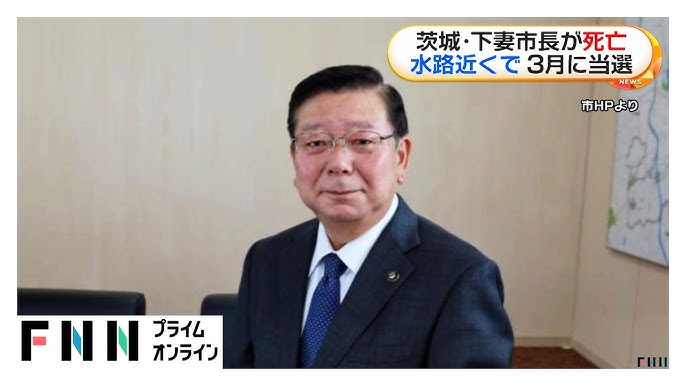
IBARAKI (TR) – Early on June 15, Toyoji Sudo, the 67-year-old mayor of Shimotsuma City, was found dead in an agricultural drainage canal in the neighboring town of Yachiyo.
While Ibaraki Prefectural Police are treating the death as a likely suicide, the sudden demise of the newly minted mayor has ignited a firestorm of conspiracy theories online, reports evening tabloid Yukan Fuji (June 19).
Sudo, a veteran city councilor, had just taken office in April after winning a tightly contested mayoral race in March by a razor-thin margin of 262 votes. Campaigning on a platform of “Revitalizing Shimotsuma,” Sudo had shown strong enthusiasm for overhauling neglected city facilities. His abrupt death just two months into his term left both locals and netizens deeply suspicious.
The bizarre location of the body fueled immediate skepticism. The situation exploded into a full-blown conspiracy when an AI-generated illustration depicting a man hanged from a water gate went viral on X.
The post, captioned “Is it just me, or does this look like a public execution?”, racked up over 11.6 million views in a single day. Commenters quickly drew sensational parallels, likening the death to “cartel executions in Mexico” where rival gangs hang victims from infrastructure as a warning.
Bounty system
Adding fuel to the fire, internet sleuths baselessly linked Sudo’s death to a controversial new prefectural policy regarding foreign labor. Ibaraki Prefecture, which logs the highest number of illegal foreign workers in Japan — mostly in the agricultural sector — recently implemented a bounty system paying 10,000 yen for tips leading to the arrest of illegal employers. Because Sudo was found in an agricultural canal, online rumors suggested he was silenced by underground syndicates.
However, a Shimotsuma city councilor who served as Sudo’s campaign manager firmly dismissed the rumor, stating Sudo had zero involvement with the prefectural bounty policy and never mentioned it in his political platform.
Meanwhile, real-world clues point to personal distress. According to a weekly magazine report, a city hall staffer noted that during a municipal assembly meeting just two days before his death, Sudo appeared unwell, constantly mumbling and speaking in a barely audible tone.
Personal issue or scandal
Atsushi Takano, a former detective with the Tokyo Metropolitan Police Department’s elite First Investigation Division, pointed out the fatal “gaps” in the local police’s public relations strategy that allowed these rumors to fester.
While Takano noted that choosing a canal for suicide is not actually uncommon in flat, rural areas lacking tall buildings or trees, he criticized the police’s simplistic announcement that the case was “suicide based on the scene.”
“To determine suicide or murder, deep-dive investigations are essential — checking location data, security cameras, how the rope was obtained and, most importantly, the motive,” Takano explained.
He suggested police might already know the motive — potentially a personal issue or scandal — but are withholding it to protect the late mayor’s honor and his grieving family. “However, in today’s era of rampant SNS speculation, police leave themselves vulnerable to internet mobs with these brief explanations. How they release information is critical.”
While determining the exact cause of death requires balancing public interest with the family’s privacy, the bizarre late-night death of a sitting public official demands more than a one-line dismissal from authorities. Without a transparent explanation of the investigative process, local police risk allowing baseless rumors to further disrupt city operations and the community’s mourning.