
TOKYO (TR) – A reporter participating in a police-sponsored drunk driving awareness course learned the hard way about the fatal realities of driving under the influence after plowing his vehicle into a pedestrian dummy, reports TV Asahi (Oct. 26).
Last month, local police teamed up with a beer manufacturer to host a “drunk driving experience class” for about 20 participants, including beverage industry workers and media representatives. The event was held in response to a July revision to the Road Traffic Act that established clearer criteria for driving while intoxicated.
Before getting behind the wheel on a closed course, participants heavily consumed alcohol to gauge its effect on their motor skills.
“I had five or six drinks,” one participant said. “Embarrassingly, I’m quite confident in my driving.” Another, who had consumed three beers, wine, and awamori liquor, admitted, “I have nothing but anxiety.”
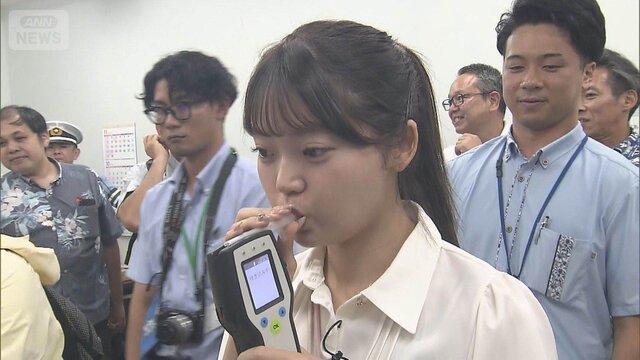
Reporter Runa Nakamura downed four cans of beer and four glasses of wine in roughly an hour. A pre-drive breathalyzer test confirmed his alcohol levels had reached the legal threshold for drunk driving.
Accompanied by a driving instructor in the passenger seat, Nakamura navigated a closed test track. While he successfully—albeit slowly—managed to clear an L-shaped crank, his cognitive functions failed him during an emergency hazard drill.
Despite receiving a direct verbal warning from the instructor to hit the brakes as a pedestrian dummy appeared on the road, Nakamura’s reaction time severely lagged, and he ran directly over the figure.
“I usually consider myself a confident driver, but even after being told in advance to step on the brakes, I still ran it over,” Nakamura said after the test. “I couldn’t even tell my left from my right anymore. I realized just how terrifying drunk driving truly is.”
According to authorities, Japan has seen 649 fatal drunk driving accidents over the past five years, with approximately 60 percent of these deadly crashes occurring between 10:00 p.m. and 5:00 a.m.
Police are urging the public to maintain a strict zero-tolerance policy.
“The most important thing is to not drink and drive, not let others do it, and not forgive it,” authorities stated. “It is vital to create a societal atmosphere where people step in to stop one another.”