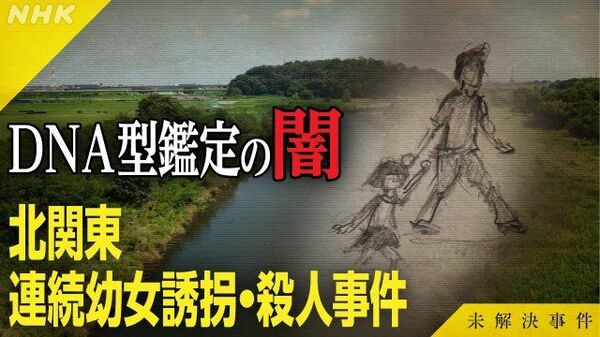
TOKYO (TR) – Following a massive public response, public broadcaster NHK has announced the rebroadcast of an explosive documentary detailing the dark truth behind a string of unsolved child murders in the North Kanto region and the flawed police DNA tests that derailed the investigation.
The original broadcast of “Unsolved Cases File.19: North Kanto Serial Young Girl Kidnapping and Murder Cases” on September 23 generated a firestorm online. Celebrities, including comedian Koji Higashino and writer Osamu Suzuki, took to X to praise the shocking exposé, prompting NHK to schedule a rebroadcast for 12:35 a.m. on October 1.
Between 1979 and 1996, five young girls were kidnapped and murdered within a 10-kilometer radius spanning Tochigi and Gunma prefectures. All five cases remain unsolved. In May of this year, the National Police Agency (NPA) finally admitted in a Diet session that the possibility of a single serial killer orchestrating the crimes “cannot be denied.”
“Deep darkness”
The possibility of a single perpetrator only emerged following the exoneration of Toshikazu Sugaya in the 1990 “Ashikaga Incident.” Sugaya was forced into a false confession and handed a life sentence based on the newly introduced MCT118 DNA testing method. He languished behind bars for 17 years before modern DNA testing definitively proved he was not the killer.
Despite this catastrophic failure of justice, the NPA continues to stubbornly insist that the original testing method was reliable. Joining forces with veteran investigative journalist Kiyoshi Shimizu, who has relentlessly pursued the truth behind the serial murders for years, the NHK crew plunged into the “deep darkness” of the police’s forensic science.
The investigative team traced the origins of the MCT118 method to the United States and uncovered new suspicions regarding other major criminal cases where the flawed test was utilized by Japanese police.
More devastatingly, the documentary reveals that investigators’ blind faith in the false DNA match to Sugaya led them to erase a crucial eyewitness account from their radar. At the time, a man resembling the anime character “Lupin III” was spotted with a young girl near a riverbank close to the crime scene—a lead that was ultimately ignored.
Botched police work
While an innocent man sat in prison for nearly two decades, the true killer roamed free, and the statute of limitations quietly expired on four of the five murders. Today, only the fifth and final case remains under active investigation.
For the families left behind, the pain of the botched police work continues in silence.
“The victims, who should raise their voices the most, lose their ability to speak out and gradually withdraw into themselves,” one bereaved family member told the program. “That is what an unsolved case is.”