
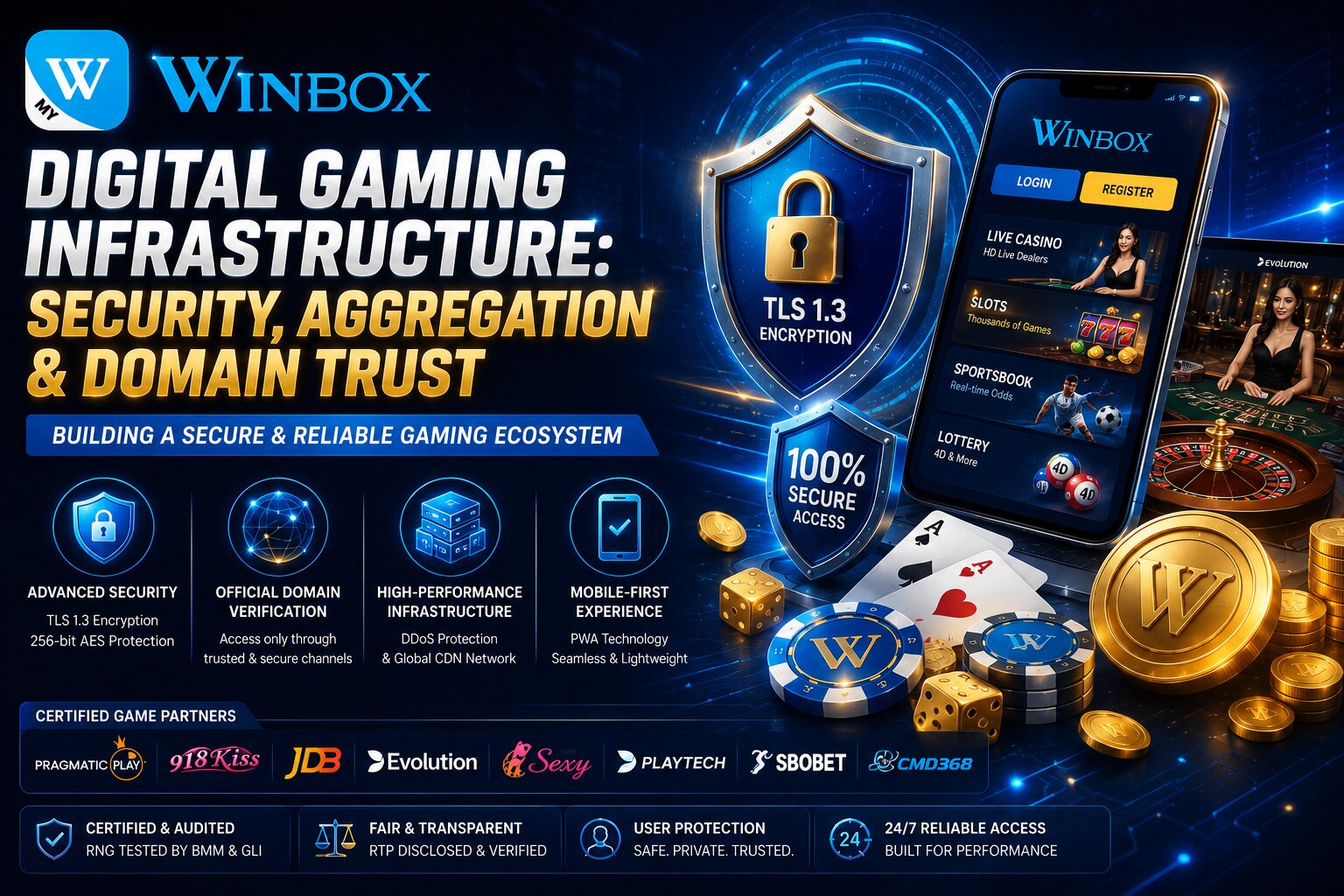
 As the digital entertainment sector continues to expand, online platform security, infrastructure resilience, and user experience have become core operational priorities. With users demanding low-latency interactions and financial data protection, evaluating platforms requires a clear understanding of backend architecture, software auditing standards, and official domain verification.
Across the Asian digital entertainment ecosystem, established operators—such as Winbox—are frequently cited in technical discussions as prime examples of how unified game aggregation and high-capacity network migration can be implemented securely.
Network Security Protocols & Channel Verification
Data privacy and transactional safety remain critical benchmarks for any high-traffic digital hub. Modern web infrastructure enforces multi-layered encryption protocols to defend against payload interception and phishing attempts.
Key Security Infrastructure Standards
- Transport-Layer Encryption: Modern platforms adopt TLS 1.3 encryption combined with 256-bit AES protocols, securing dynamic communications between user browsers and backend database clusters.
- Domain Consolidation: To safeguard users from counterfeit mirror sites and malicious spoofing, operators consolidate traffic into authentic access points. Utilizing verified gateways, such as the official Winbox login gateway, helps ensure connections remain strictly within an encrypted environment.
- Volumetric DDoS Scrubbing: Multi-tiered Web Application Firewalls (WAF) and scrubbing networks buffer central application servers, mitigating system downtime during high-concurrency peak hours.
Independent Game Aggregation & Software Diversity
Modern platforms have largely shifted away from single-source proprietary software toward multi-vendor aggregation models. This approach grants users access to certified content libraries hosted by established global game studios.
Core Software Categories
- Slot Game Libraries: Broad options featuring classic reels and multi-line jackpots developed by audited studios such as Pragmatic Play, 918Kiss, and JDB.
- Live Dealer Integration: Ultra-HD, low-latency video streaming supplied by recognized live casino software developers including Evolution Gaming, AE Sexy, and Playtech.
- Sportsbook Systems: Automated odds engines and real-time sports market tracking powered by specialized providers like SBOBET and CMD368.
Mathematical Fairness & Software Auditing
System credibility relies heavily on verifiable fairness. Reputable operators integrate software whose Random Number Generators (RNG) are independently verified by recognized testing laboratories such as BMM Testlabs or Gaming Laboratories International (GLI).
Publishing competitive Return-to-Player (RTP) metrics and maintaining unmanipulated game outcomes ensure a transparent operating environment for users across all gaming verticals.
Mobile Architecture & Progressive Web Apps (PWA)
With mobile web usage accounting for the majority of user traffic, digital entertainment systems prioritize mobile-first engineering. By leveraging Progressive Web App (PWA) methodologies, platforms enable fluid navigation and real-time session synchronization directly inside standard mobile web browsers, eliminating the need for heavy native app installations.
Conclusion
Evaluating modern digital entertainment hubs requires looking beyond superficial features to analyze core infrastructure. By prioritizing verified official domains, robust TLS encryption, certified game partners, and transparent RNG auditing, platforms establish sustainable standards for security and operational integrity.
Article Information
- Published By: Tech & Digital Media Editorial Team
- Category: Web Infrastructure, Network Security & iGaming Systems