TOKYO (TR) – Screams echoing in the middle of the night, groups of foreign tourists loitering in the streets and strangers banging on residential doors.
This is the new reality for locals in Ota Ward, which is home to Haneda International Airport. In the ward, complaints regarding private vacation rentals, or minpaku, have skyrocketed more than fivefold in just one year.
Ten years ago, Ota Ward became the first municipality in Japan to introduce a “Special Zone Minpaku” system. Unlike standard vacation rentals, which are strictly capped at 180 operating days per year, these special zone properties have no limit.
Originally intended to utilize vacant rooms to accommodate a massive influx of foreign tourists, the system has effectively turned quiet residential neighborhoods into unregulated hotel zones, reports Yomiuri TV (Aug. 3).
“I couldn’t sleep”
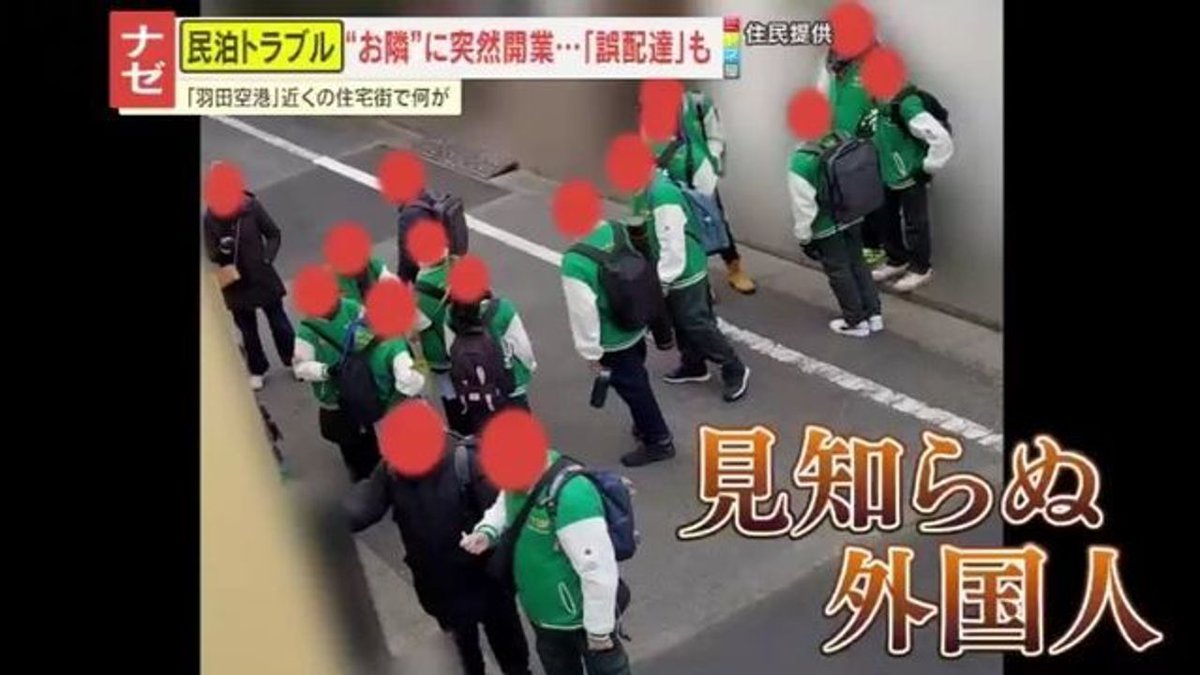
Residents are now finding themselves besieged by the tourism boom. Local streets are plastered with multilingual signs reading “No Minpaku.”
One long-term female resident described how her life was thrown into chaos when a minpaku opened right next door to her house earlier this year, followed by another eight-person rental directly behind her property.
“I couldn’t sleep because of the noise, so I spent millions of yen installing double-paned, highly soundproof glass on every window,” the woman said. “It helped a little, but I can still hear them.”
Video footage captured by the woman shows groups of youths shouting loudly on the street outside her home at night, as well as the screams of children echoing from the rentals for over an hour.
“I was absolutely terrified”
Because the rental next door sits on the same plot of land and shares her address, the woman has also been plagued by misdelivered packages and terrifying late-night encounters.
“Once, while we were eating dinner, the doorbell rang. I looked out and saw a large group of foreigners shouting in English,” she recalled. “I was absolutely terrified.”
Residents say absentee management companies have effectively dumped their responsibilities onto the locals. “If there’s no one managing the property like a hotel, the neighbors are the ones forced to deal with it,” the woman said. “We just have to endure it. It’s completely unreasonable.”
Pushed to their limit, residents submitted a petition with approximately 30,000 signatures to Ota Ward in June, demanding an immediate overhaul of the special zone guidelines.
“Zero-day rule”
Nationwide, the situation has become so severe that the Japan Tourism Agency recently reversed its long-standing policy, giving municipalities the green light to implement a “zero-day rule” that effectively bans standard minpaku operations due to escalating noise and garbage disputes. However, a massive loophole remains: this ban does not apply to Ota Ward’s special zones.
In response to the backlash, Ota Ward recently revised its guidelines, asking operators to set up 24/7 complaint hotlines and ensure staff can rush to a property within 10 to 30 minutes in an emergency. However, authorities gave operators a generous three-year grace period to comply and have bluntly refused to suspend new minpaku applications.
Attorney Yasusaburo Takehara criticized the local government’s sluggish response to the crisis.
“They are essentially trying to turn all of Ota Ward into a hotel,” Takehara said. “Once they realized that these places cannot function without on-site managers, they should have acted immediately. Real damage is happening right now—a three-year transition period is simply too long.”