
KYOTO (TR) – As record-breaking crowds descend on Japan’s historic sites for the autumn foliage season, local authorities are struggling to contain a surge in anti-social behavior and vandalism, most notably at the world-famous Arashiyama bamboo forest, reports TV Asahi (Nov. 29).
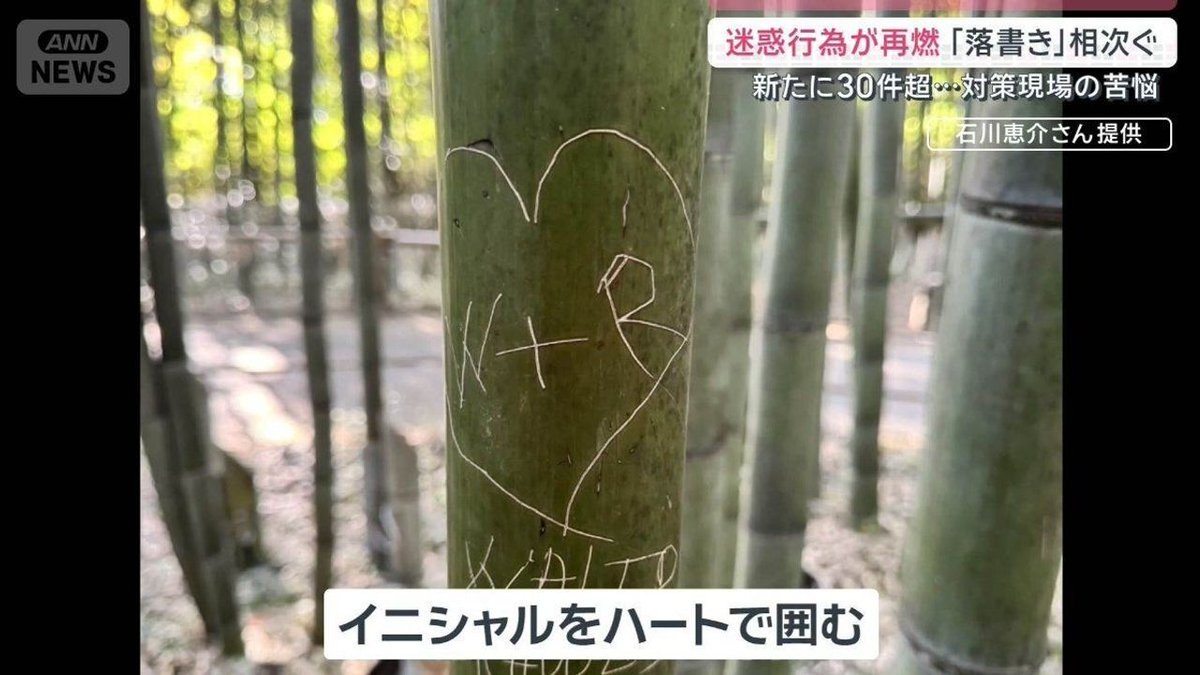
Despite aggressive efforts by local business associations to curb destruction, officials recently discovered more than 30 new instances of graffiti carved into the iconic bamboo stalks. The markings, which include names like “Kim” and various initials encased in hearts, have appeared in sections of the grove that were previously left unprotected.
“We thought we had the situation under control,” said Keisuke Ishikawa, chairman of the Arashiyama Shopping District Association. “But as soon as we secured one area, the vandals just moved to another.”
“Patrol agents”
To combat the wave of damage, the association has deployed special “patrol agents” to monitor the grove through early December. These guards carry signs in four languages, warning tourists against defacing the bamboo and intervening when visitors attempt to touch or climb the plants.
The vandalism is just one facet of the “overtourism” crisis currently choking Kyoto. As the city continues to see record-breaking visitor numbers—surpassing 60 million last year—local residents and officials are battling a litany of infractions, including tourists trespassing on active train tracks for photos, illegal street smoking, and massive transit congestion.
In a desperate bid to manage the foot traffic, authorities have launched trial programs such as subsidized “shared taxis” to alleviate pressure on local bus lines and are pushing eco-friendly waste reduction initiatives, including the introduction of edible spoons.
Chiba Prefecture
While Kyoto grapples with unruly crowds, other regions are fighting a different battle. In Chiba Prefecture, the Yoro Valley is struggling to recover from the devastation of Typhoon No. 25, which struck in September. The disaster caused landslides, cut off critical roads, and left local hot spring inns without power or water for weeks.
While the region has partially reopened for the autumn foliage festival, local business owners say the damage remains visible. “Some buildings are still leaning, and we are nowhere near the visitor levels we saw before the disaster,” said Yasuo Akiba, head of the Yoro Valley Tourism Association.
As the peak foliage season nears its end, local officials in both Kyoto and Chiba are bracing for the final rush, balancing the economic necessity of tourism against the preservation of their cultural and natural heritage.